They Keep Making Lists. The Sacred Keeps Ignoring Them.

A thousand-year-old heiau, a government list, and the ground that outlasts both.
The tears of the heavens restore the earth.
Hawaiian proverb, Kauali'ili'i Heiau, Kona, Hawai'i
I read those words on a sign at the edge of a heiau, an ancient Hawaiian sacred site, that sits inside a resort complex on the Big Island of Hawai'i. There were tourists nearby with mai tais. There was a pool around the corner. And there, integrated into the ordinary landscape of a vacation destination, was ground that people have considered holy for more than a thousand years.

I stood there longer than I expected to. Not because of what the sign said about the heiau's history, though the history is remarkable. I stood there because of a question the proverb planted in me, one that I could not stop turning over: who gets to say what is sacred?
Empires have always tried to manage the sacred. They license it, restrict it, rank it, and deploy it in service of their own legitimacy. What they have consistently failed to understand is that the sacred is not a resource to be managed. It is the ground beneath the ground. It existed before the institution arrived, and it remains after the institution has dissolved into history.
The Kauali'ili'i Heiau has been a site of prayer and ceremony since approximately 800 to 1000 CE. For context: that is roughly four hundred years before Columbus sailed, six hundred years before the United States existed as an idea, and more than a millennium before any government agency compiled a list of approved religions. The people who consecrated this ground were not waiting for official recognition. They understood something about the relationship between the human community and the living earth that many of us are still trying to learn.
I arrived in Hawaii carrying a lot. And the strong stones of the heiau were waiting.
When the Government Decides Which Prayers Count
Shortly before I left for the Big Island, the Pentagon quietly announced a reduction in the number of faith traditions it officially recognizes. A bureaucratic decision with a theological implication: some sacred paths, it seems, are more legitimate than others. In a country that constitutionally guarantees the free exercise of religion, the government has decided to rank it.
This is not a new story. It is, in fact, one of the oldest stories power tells. The Roman Empire ranked religious traditions. The medieval church issued or revoked authorization to practice. Colonial governments across the Pacific, the Americas, and Africa systematically suppressed indigenous spiritual life, sometimes by law, sometimes by force, always with the implicit claim that official religion and authentic religion were the same thing. They were not then, and they are not now.
The sign at the Kauali'ili'i Heiau asks visitors not to desecrate the site. It says nothing about government authorization. The heiau does not require it. Lono, the Hawaiian deity of rain and renewal to whom this site was dedicated, was sending rain to the Big Island long before anyone in Washington decided which deities qualified for institutional respect. The sacred does not diminish because power ignores it. The sacred simply continues.
This moment in American life, in which institutions are sorting and ranking and restricting with increasing confidence, continues a thread that readers of this blog have been sitting with. A few weeks ago we reflected on the Council of Nicaea, where a room of bishops took a vote and declared the theological losers heretics. The Pentagon's list is a different document from a different century. The logic is identical: power decides what counts as sacred, and everyone else adjusts accordingly.
The heiau has been holy for over a thousand years, uncredentialed and undiminished. It will remain so.
The Earth Is Ailing
The Hawaiian proverb does not begin with reassurance. It begins with diagnosis. The earth is ailing. That is an honest assessment of this moment. Missiles are being exchanged in one of the world's most consequential shipping corridors. Governments are deciding whose prayers count. A generation of young people is inheriting institutions that have grown visibly unreliable, and they are building their lives anyway, which is its own form of courage.
Unity philosophy has never asked us to pretend otherwise. Charles Fillmore did not teach denial. He taught that consciousness participates in the world it experiences, which means that honest witnessing is itself a spiritual act. We do not serve healing by refusing to name the illness. We do not serve peace by performing a contentment we do not feel. Jesus wept at the tomb of Lazarus. He did not explain to the mourners that their grief was metaphysically incorrect.
I returned from Hawaii to a season of personal transition that carried its own weight alongside the world's. My youngest son, who is an extraordinary human and whose life is unfolding on an extraordinary path, graduated from college. The joy of that milestone is real and full. So is the grief. He will be building his life thousands of miles from any family, and grief does not wait for permission. It shows up in the middle of celebrations, in the car on the way home from a ceremony, in the particular stillness of a house where someone used to live.
The Hawaiian tradition that built this heiau understood that the first move toward restoration is honest acknowledgment. The earth is ailing. The question is not whether that is true. The question the proverb asks is: what is its medicine?
The Tears of Heaven
The medicine the proverb names is rain. In the Hawaiian understanding that shaped this heiau, rain was not merely weather. It was the expression of Lono's presence, the grief and generosity of the Divine meeting the thirst of the earth. Rain does not fall because the earth has earned it. It falls because the nature of heaven is to restore.
The grief I carry about my son moving so far away is real, and it is also, at its root, a form of love. Grief is what love feels like when it cannot hold on. There is something healing in naming that clearly rather than rushing past it toward acceptance. The tears matter. They are part of the medicine. This is true not only for parents releasing children into their own lives, but for anyone standing at the threshold of a change that is bittersweet.
The pattern of empires trying to control the sacred, the pattern of fear driving nations toward conflict, the pattern of institutions narrowing rather than widening the circle of belonging: these are not new patterns. They are very old ones. They have never been healed by force, by counter-legislation, or by winning an argument on social media. They have been interrupted, again and again throughout history, by people who chose to respond to a fearful world with something the fearful world could not generate from within itself: Love.
This is what I have been calling Sacred Repatterning: the practice of meeting the world as it is, without denial, and allowing Love to reorganize what happens next. It is not passive. It does not ask us to accept injustice or to stop advocating for dignity. It asks us to do those things from a different center: from the awareness that beneath the conflict, beneath the bureaucratic arrogance, beneath the grief of transitions and the fear of what comes next, there is a ground that has never been broken. Sacred ground. The ground the builders of the heiau knew, that the Hawaiian proverb names, that every authentic spiritual tradition in human history has been trying, in its own language, to describe.
Presence Is the Practice
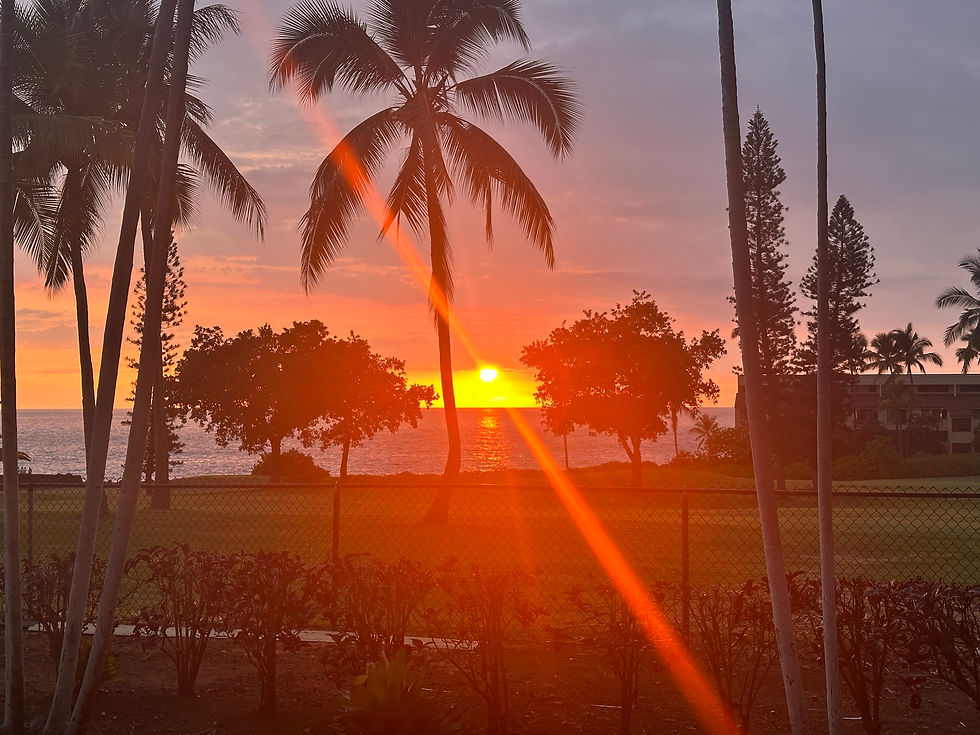
On the last evening of our trip, I watched the sun set over the Pacific from the same property that holds the heiau. The sky went coral, then amber, then a deep burning orange that seemed briefly impossible, the kind of light that makes you stop whatever you are doing and simply receive it. That kind of moment does not ask for interpretation. It only asks for presence.
My son is extraordinary, and his life is unfolding on an extraordinary path. The world he is walking into is complicated and beautiful and frightening and full of more possibility than the fearful headlines suggest. He will keep building something meaningful in it. The distance between us will be measured in miles and closed in love.
The Pentagon's list does not determine which prayers reach heaven. The missiles do not have the last word on what is possible between human beings. The ancient heiau sits in the resort grounds, unhurried, uncredentialed, and completely indifferent to whether any governing body recognizes its authority. It has been holy for over a thousand years. It will remain holy long after the current arrangement of power has rearranged itself again.
The earth is ailing. It always has been, in one way or another. And the tears of heaven, the Love that meets the world's thirst without being asked, without requiring credentials, without waiting for official recognition, have always been the medicine.
The ground on which you stand is sacred simply because you are on it. Let it hold you. Then go and be rain.


Comments